In the fast-paced world of construction, an accurate estimate is much more than just a price tag; it is the heartbeat of your entire business operation. It significantly impacts a construction project's planning, bidding, design, and overall management phases. Furthermore, these estimates provide contractors and clients with the foundational information that enables them to track progress efficiently and maintain healthy cash flows.
With the insight gained from accurate estimation, it becomes much easier for contractors to decide what is feasible for their projects, ultimately saving significant time and money for both parties involved. However, the industry is reaching a turning point. Due to rapid changes in technology over the years, traditional manual methods are becoming a liability. In contrast with old-school spreadsheets, modern methods are far more efficient and much faster.
In this guide, we will explore how artificial intelligence cost estimation and machine learning are creating a novel method to achieve highly precise estimates using sophisticated, yet user-friendly techniques.
How is AI used in construction estimating?
Artificial Intelligence is no longer a buzzword; it is becoming an essential part of modern construction cost estimating. Instead of relying only on manual calculations that can take days, AI systems can process massive amounts of project data in seconds.
Here is how AI is practically integrated into the estimating workflow:
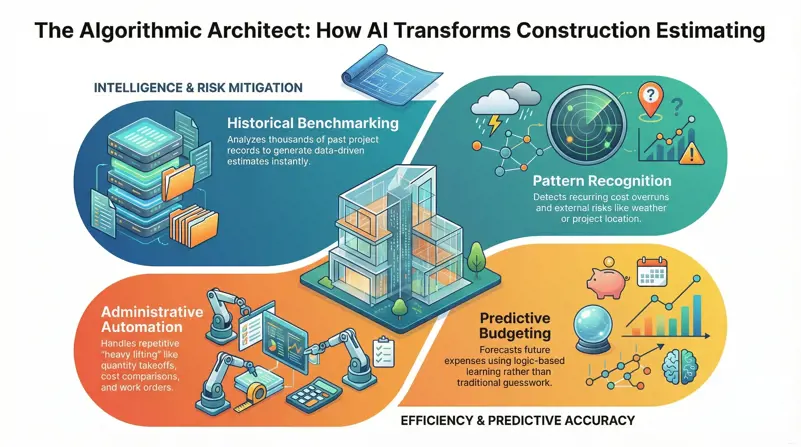
- Data Analysis & Historical Benchmarking: AI systems analyze thousands of historical project records, past material costs, and labor productivity rates to generate data-driven estimates. This prevents the "starting from scratch" syndrome every time a new bid comes in.
- Pattern Recognition for Risk Mitigation: AI is exceptionally good at identifying patterns that humans might overlook. For example, AI for building cost estimation can detect recurring cost overruns in specific types of projects or recognize how external factors like weather, location, or project size historically affect the budget.
- Automation of Administrative Workflows: Beyond the math, AI handles the heavy lifting of repetitive tasks. This includes quantity takeoffs, cost comparisons, and even the generation of work orders. By reducing manual workflows, contractors can spend more time on-site and less time behind a laptop.
- Predictive Maintenance of Budgets: By learning from past data, AI tools can predict future expenses with greater confidence, allowing for a "buffer" that is based on logic rather than guesswork.
The Role of Machine Learning (ML) in Modern Construction
To understand the "how," we must look at Machine Learning. ML allows computers to perform tasks without being explicitly programmed for every scenario. It uses large amounts of structured and unstructured data to generate predictions.
In construction, ML relies on algorithms that improve the more information they gather. For instance, if you specialize in kitchen remodels, the system learns your specific sub-contractor rates and material waste patterns. Unlike traditional software, you don't need to retrain the model every time market prices shift; the system adjusts its confidence levels based on the new information it gathers from the web and your internal data.
The Connected Ecosystem: Beyond Just Estimating
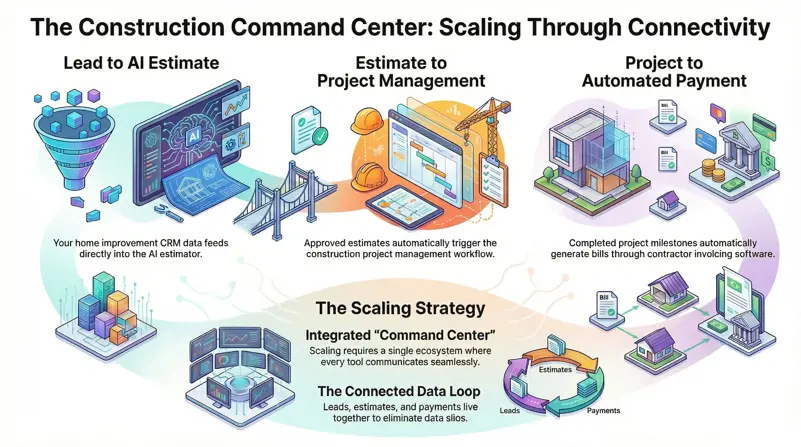
To scale a construction business today, you need more than just a calculator. You need a "Command Center" where every tool talks to the other. 247pro creates a seamless loop where your leads, estimates, and payments live in one single ecosystem.
- Lead to Estimate: Your best crm for home improvement feeds data directly into the AI estimator.
- Estimate to Project: Once approved, the estimate triggers your project management software construction workflow.
- Project to Payment: Completed milestones automatically generate bills through your invoicing software for contractors.
What is the best AI for construction estimating?
The best AI for construction estimating is not just a single algorithm—it is a combination of smart technologies working together to create a connected ecosystem. A strong AI-powered solution should be able to analyze historical cost data, adapt to changing market conditions, and continuously improve its predictions.
Key features to look for in a top-tier AI estimating tool:
- Integration Capability: The tool must work with your existing project management software and construction modules. If your estimate doesn't talk to your project schedule, you're missing half the value.
- Predictive Analytics: It should provide risk alerts. If a material price is trending upward globally, the AI should flag this before you send out your bid.
- User-Centric Design: It is vital that AI solutions are designed for construction professionals, not data scientists. The best systems translate complex data into clear cost breakdowns and budget forecasts that any project manager can understand.
- Real-Time Data Feeds: The software should connect with live material databases to ensure that your artificial intelligence cost estimation reflects today’s prices, not last year’s.
What is the most popular construction estimating software?
Construction estimating software has evolved significantly. Today, the most popular platforms are those that provide an "all-in-one" solution. Contractors no longer want to jump between five different apps to manage one project.
The industry leaders focus on these core functionalities:
- Seamless Transition to Execution: The software should allow you to convert a winning estimate into an active project immediately.
- Change Management: Projects rarely go exactly as planned. Popular tools now include specialized remodeler change order software to track adjustments. Having a dedicated construction change order management software ensures that every "extra" requested by the client is documented and billed.
- Financial Integration: To stay ahead, contractors use integrated invoicing software for contractors. This ensures that the moment a milestone is reached (based on the original AI estimate), an invoice is generated and sent.
The most widely used platforms are those that create a smooth and connected workflow from the first bid to the final invoice, integrating CRM, project tracking, and financial management into one dashboard.
Overcoming Challenges in Cost Estimation
Even with AI, contractors face real-world challenges. However, technology offers new ways to solve old problems:
- Ambiguous Requirements: AI helps by analyzing ambiguities in project descriptions and comparing them to similar past projects to fill in the blanks.
- Optimism Bias: Humans naturally underestimate how long a task will take. AI provides a "reality check" based on actual historical performance data.
- Market Volatility: By using AI in construction estimating, firms can broaden their competitiveness by producing precise estimates even when limited observations are available.
Challenges vs. AI Solutions: The Competitive Edge
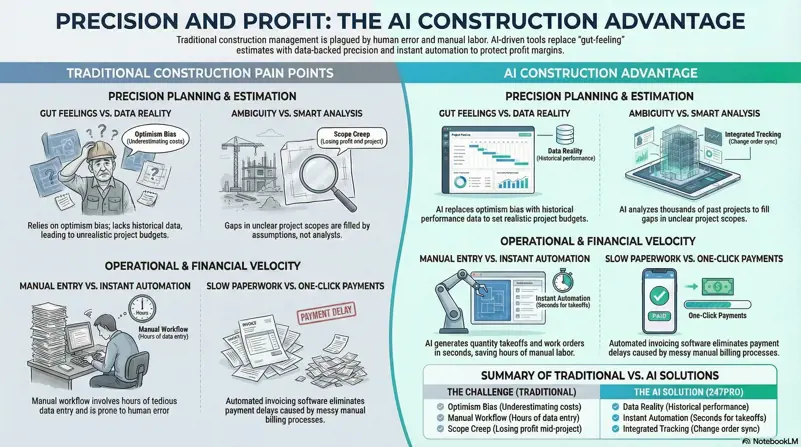
Every General Contractor knows that the real world doesn't always match the blueprints. Traditional estimation often fails because it can’t keep up with human error and market volatility.
Here is how AI-driven solutions solve the most common "Pain Points" in the industry:
| The Challenge (Traditional Way) | The AI Solution (247pro Way) |
| Optimism Bias: Underestimating time and costs due to "gut feelings." | Data Reality Check: AI uses actual historical performance to set realistic budgets. |
| Ambiguous Requirements: Wasted time trying to figure out unclear project scopes. | Smart Analysis: AI compares ambiguities with thousands of past projects to fill the gaps. |
| Manual Workflow: Hours spent on quantity takeoffs and data entry. | Instant Automation: AI handles takeoffs and generates work orders in seconds. |
| Scope Creep: Losing profit when clients change their minds mid-project. | Integrated Tracking: Direct sync with construction change order management software. |
| Slow Invoicing: Waiting weeks to get paid because the paperwork is a mess. | One-Click Payments: Automated billing via invoicing software for contractors. |
Why This Comparison Matters
For a growing construction firm, these aren't just technical features; they are financial lifelines. By moving away from the "Manual Way," you aren't just adopting a new tool; you are protecting your profit margins. Integrating your estimator with specialized remodeler change order software ensures
Final Thoughts
Artificial Intelligence and Machine Learning are transforming the way we build. By leveraging historical data, predictive algorithms, and automation, these technologies help contractors save time, reduce errors, and make more informed decisions.
As the construction industry continues to embrace these advancements, companies that adopt these solutions early will gain a significant competitive advantage. For contractors and project managers looking to stay ahead, exploring AI-powered estimating solutions and complementary tools like invoicing and CRM systems is no longer optional; it is essential for survival in a digital-first market.
FAQ: Everything You Need to Know
1. How accurate is AI in construction project cost estimation?
AI significantly improves accuracy by removing human bias and using massive datasets. While the final accuracy depends on data quality, in repetitive or complex projects, AI consistently outperforms traditional manual methods by identifying hidden cost drivers.
2. Can AI predict indirect and hidden costs?
Yes. AI predictive algorithms can account for factors such as weather delays, regulatory changes, and permit costs, provided the relevant historical data is available. This helps in creating a much more realistic total budget.
3. What skills are required to use AI for cost estimation?
Most modern software is designed for ease of use. You don't need a degree in data science. If you are familiar with basic construction management, you can master an AI-driven interface with minimal training.
4. How can AI integrate with my existing company systems?
Top-tier AI tools are designed to integrate with ERP, CRM, and project management software construction. This ensures that your estimates are updated alongside your resource and client management.
5. Is AI useful for small projects or only large-scale ones?
While AI offers massive benefits for complex projects, it is equally valuable for small remodelers. It saves hours of administrative time, allowing small teams to produce professional-grade bids that compete with much larger firms.
6. How does AI handle sudden project changes?
AI integrates with remodeler change order software to quickly update budget estimates. It can predict the ripple effect of a single change on the entire project timeline and cost, preventing profit loss.