Home remodeling can be exciting, but many homeowners face a harsh reality: the actual cost of remodeling is often much higher than expected. Even a small project like updating a bathroom or kitchen can significantly impact your budget.
According to 2026 data:
- Average full-home renovation cost in the U.S.: $125,000 – $250,000
- Small projects (one room or bathroom): $5,000 – $35,000
- Luxury projects and large homes: $300,000 – $600,000+
This article will break down home remodeling costs step by step, introduce project management tools, and share 2026 trends to help you plan a cost-effective and professional renovation.
The 2026 Market Landscape: Answering "How Much Does It Cost to Remodel a House?"
Homeowners often underestimate renovation costs by 20–30%. As a professional, your role is to bridge the gap between media-driven expectations and the reality of skilled trade labor, insurance burdens, and code compliance.
2026 National Averages (Contract Value):
- Full-Home Gut Renovation: $125,000 – $250,000+
- Single Room (Wet Area): $25,000 – $60,000
- Luxury/Custom Projects: $300,000 – $600,000+
Whole Home Renovation Cost by Square Footage
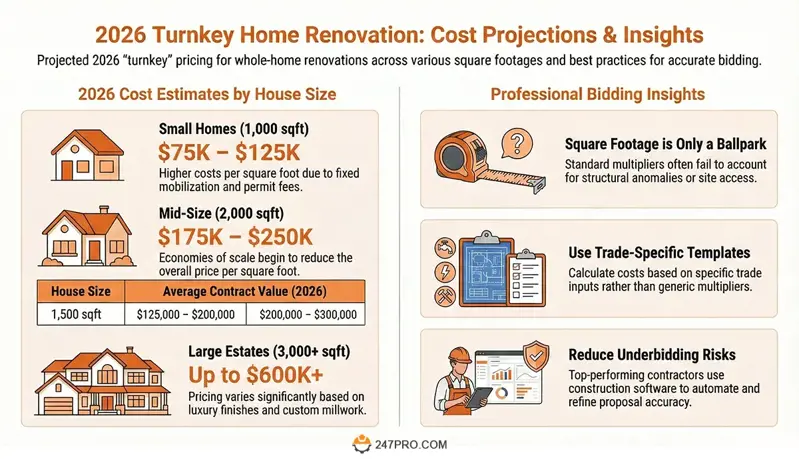
Estimating by square footage remains a quick ballpark method during pre-construction qualification, though line-item estimating is required for accurate job costing. The following data reflects "turnkey" pricing, including standard MEP (Mechanical, Electrical, Plumbing) updates.
| House Size | Average Contract Value (2026) | Operational Notes |
| 1,000 sqft | $75,000 – $125,000 | Higher cost per sqft due to fixed mobilization & permit costs. |
| 1,500 sqft | $125,000 – $200,000 | Standard 3/2 layout typically falls here. |
| 2,000 sqft | $175,000 – $250,000 | Economies of scale begin to dilute the price per sqft. |
| 2,500 sqft | $200,000 – $300,000 | Often includes significant flooring/paint scope. |
| 3,000+ sqft | $250,000 – $600,000+ | High variance based on luxury finishes and custom millwork. |
Operator Insight: Square footage estimates often fail to account for structural anomalies or site access issues. Top-performing contractors on the platform use construction proposal software to build templates that auto-calculate based on specific trade inputs rather than generic multipliers, reducing the risk of underbidding.
Room-by-Room Cost Breakdown & Scope Analysis
Analyzing 2026 Trends & Costs: How much does a kitchen remodel increase home value?
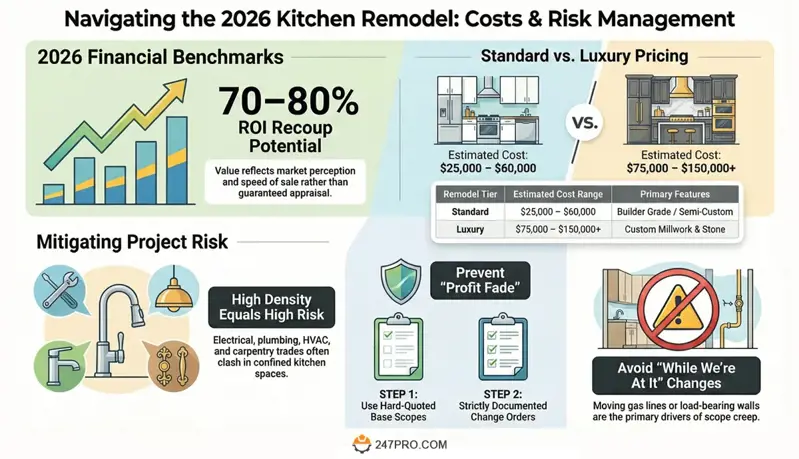
Kitchens represent the highest risk for scope creep due to the density of trades (electrical, plumbing, HVAC, carpentry, and stone) in a confined space.
2026 Cost Benchmarks:
- Standard (Builder Grade/Semi-Custom): $25,000 – $60,000
- Luxury (Custom Millwork/Stone): $75,000 – $150,000+
ROI & Client Expectations:
- Recoup Potential: 70–80%.
- Note: ROI reflects market perception and speed of sale, not guaranteed appraisal value.
- Contractor Insight: The primary driver of profit fade in kitchens is "while we're at it" changes (e.g., moving a gas line or load-bearing wall). Hard-quote your base scope and use strictly documented change orders for any layout modification to protect the timeline.
Bathroom Remodel Costs vs. ROI: How much does a bathroom remodel increase home value?
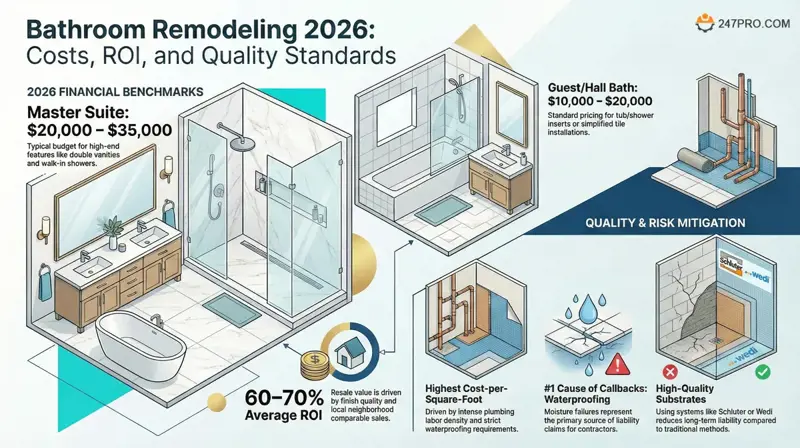
Per square foot, bathrooms are the most expensive rooms to build due to waterproofing requirements and plumbing labor density.
2026 Cost Benchmarks:
- Master Suite: $20,000 – $35,000 (Includes double vanity, walk-in shower).
- Guest/Hall Bath: $10,000 – $20,000 (Standard tub/shower insert or simple tile).
ROI & Client Expectations:
- Recoup Potential: 60–70%.
- Note: Resale value is heavily dependent on finish quality and neighborhood comps.
- Contractor Insight: Waterproofing failures are the #1 cause of callbacks and liability claims. Platform data suggests successful GCs budget for high-quality substrates (e.g., Schluter/Wedi) rather than traditional hot-mop to reduce long-term liability, even if material costs are slightly higher.
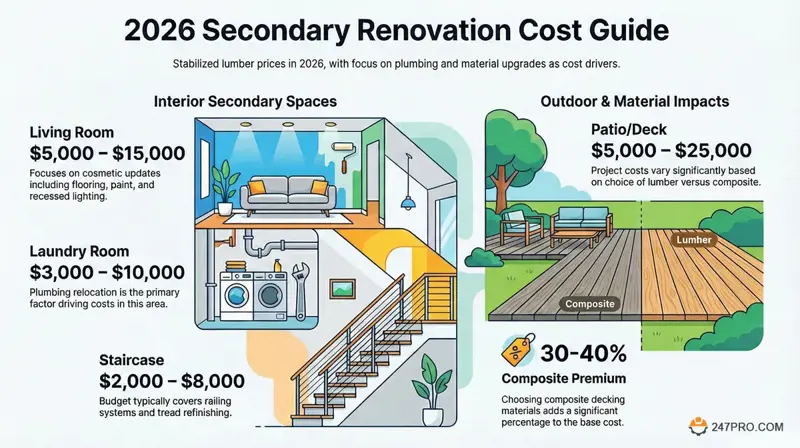
Living Room, Laundry Room, Patio, Stair, Pantry Remodel Cost
These areas are often lower margin but faster to execute, aiding cash flow velocity.
| Area | 2026 Cost Range | Scope Considerations |
| Living Room | $5,000 – $15,000 | Mostly cosmetic (flooring, paint, recessed lighting). |
| Laundry Room | $3,000 – $10,000 | Plumbing relocation is the main cost driver here. |
| Patio/Deck | $5,000 – $25,000 | Lumber prices have stabilized; composite decking adds 30-40%. |
| Staircase | $2,000 – $8,000 | Railing systems and tread refinishing. |
Cost Drivers: Where the Money Goes
To justify pricing to clients, break down the bid structure. According to 247PRO platform data, the split for a typical remodel is shifting:
- Labor (40–50%): Burdened labor rates are rising. This includes demo, trade subcontractors (MEP), and finish carpentry.
- Materials (35–40%): Finish materials (tile, fixtures) and rough materials (lumber, drywall).
- Overhead & Profit (15–25%): Insurance, project management, waste disposal, vehicle costs, and net margin.
The "Value Engineering" vs. Luxury Conversation
Clients often ask for "cheap," but experienced operators know that "cheap" materials often cost more in labor to install or repair later.
- Value Engineering: Suggest standard-size cabinets (stock) instead of custom, or LVT flooring instead of hardwood. This reduces material cost without compromising installation quality or warranty exposure.
- Luxury Spec: Custom millwork, stone slabs, and smart-home integration require specialized labor, pushing labor ratios higher.
Managing the "DIY" Client: Risk & Liability
A growing trend involves clients wanting to perform specific tasks (demolition, painting, purchasing) to save money. For professional GCs, this introduces schedule slippage, warranty gray areas, and liability.
Best Practices for Handling DIY Requests:
- Scope & Warranty Separation: Clearly define where your warranty ends. Example: "If the client performs the painting, the contractor cannot warrant the drywall finish against visible scratches or texture issues once primer is applied."
- Owner-Furnished Materials (OFM): Discourage OFM for rough-ins (valves, wiring). If clients buy non-compliant parts or perform unpermitted rough-ins that trigger inspection failures, your license remains the ultimate point of liability.
- Schedule Impact: Clients rarely work as fast as professional crews. Add buffer days to the schedule and clarify that delays caused by owner-performed work are billable.
2026 Trends Impacting Production
Aligning your services with market trends can differentiate your firm and increase bid win rates.
- Electrification & Efficiency: Demand for heat pumps, induction cooktops, and EV charger rough-ins is surging. This requires heavier electrical panel upgrades (200A+). Factor this into early estimates.
- ADUs & Multi-Gen Living: Garage conversions and basement suites are high-ticket projects. These are essentially "mini-house" builds requiring full permit packages and distinct project management tracks.
- Smart Home Integration: Low-voltage wiring is no longer optional. Clients expect CAT6 drops and neutral wires at switch boxes for smart lighting.
The Professional Workflow: Protecting Your Margin
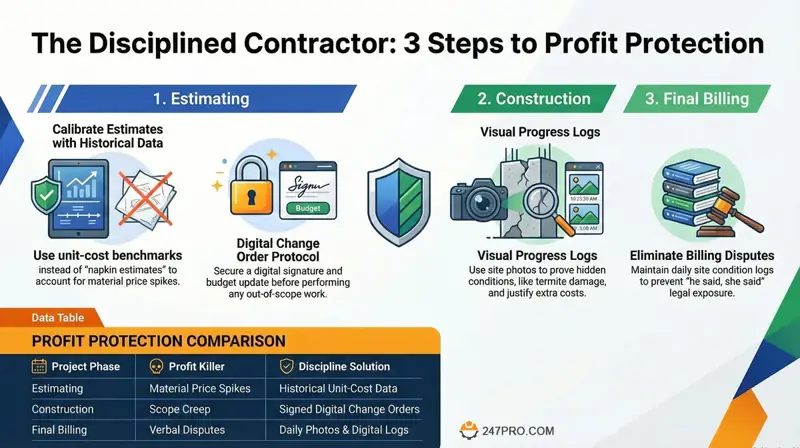
Profitability isn't just about high prices; it's about process discipline. The most successful contractors on the platform utilize specific workflows to minimize risk and accelerate billing.
1. Estimating Accuracy = Margin Protection
Avoid "stick estimates" on the back of a napkin. Use historical unit-cost data. Successful firms often use these benchmarks during estimator onboarding to calibrate new hires against company standards.
- Outcome: Reduces the risk of absorbing material price spikes and ensures every labor hour is accounted for.
2. The Change Order Protocol
Scope creep is the silent killer of net profit. If a client asks for a recessed niche after the wall is closed, that is a Change Order.
- Best Practice: Never perform out-of-scope work on a verbal agreement. Use digital change order tools to get a signature and an approved budget update before the work is done.
- Outcome: Eliminates end-of-job billing disputes and keeps cash flow positive.
3. Communication & Documentation
"He said, she said" disputes lead to unpaid invoices and legal exposure.
Action: Use construction work order management software to log daily site conditions and share progress photos. A photo of the opened wall proving termite damage justifies the extra cost immediately.
Numeric Example: The Cost of a "Small Favor"
Consider a $50,000 Bathroom Project with a 10% Net Profit ($5,000).
If you agree to a "small" client request like adding extra recessed lighting and moving a switch without a Change Order, and it costs you $1,500 in labor and materials:
- You haven't just lost $1,500 in revenue.
- You have lost 30% of the entire project's profit.
- Process Discipline: Documenting that $1,500 ensures you keep your full margin.

Margin Reality Check
Before finalizing any contract, operators must understand the difference between Gross Profit and Net Income.
- Gross Margin: Revenue minus Cost of Goods Sold (Labor + Materials).
- Net Margin: Gross Margin minus Overhead (Office, Insurance, Trucks, Marketing).
The Risk of Slippage:
Platform data indicates that contractors who fail to track Change Orders see an average net margin erosion of 4–6%. In an industry with tight margins, process discipline is not administrative overhead; it is profit insurance.
Regional Cost Variances
Labor rates are the biggest variable in the U.S. market.
| Region | Whole Home Cost Range | Market Note |
| New York / Northeast | $250,000 – $500,000 | Union-heavy influence; older housing stock requires significant remediation. |
| California / West | $200,000 – $450,000 | Strict energy codes (Title 24) and high labor burdens drive costs. |
| Texas / South | $125,000 – $250,000 | Lower labor rates; slab-on-grade foundations simplify plumbing scope. |
| Florida / Southeast | $150,000 – $300,000 | Hurricane code compliance impacts window/door pricing significantly. |
| Midwest | $100,000 – $200,000 | Seasonal limitations impact exterior schedules and general conditions. |
Conclusion: Business Sustainability Through Process
In 2026, the differentiator between a struggling contractor and a sustainable construction business is data-driven operations. By prioritizing predictable execution over aggressive pricing and strictly adhering to change order protocols, you protect your bottom line and elevate the client experience.
Next Step: Are your current estimates accounting for 2026 burdened labor rates? Review your bid templates today to ensure your unit prices reflect these updated market realities and secure your target margin.
FAQ: Handling Common Client Questions
1. How do I explain timeline uncertainty to clients?
Move away from "It will take 3 weeks" to "It will take 15 working days, subject to inspections." Explain that the critical path is often dictated by city inspections and material lead times, not just crew speed.
2. Why are my estimates higher than online calculators?
Online calculators often show "material only" or "DIY" pricing. Explain that your bid includes insurance, workers' comp, project management, and warranty protections that "truck and a ladder" handymen do not provide.
3. How do I handle "Supply Chain" excuses in 2026?
While supply chains have improved, custom items (windows, cabinets) still lag. Pre-order long-lead items before demolition begins. Use a material schedule to demonstrate that delays are often tied to selection timing, shifting responsibility to the client if they delay decisions.
4. What is the best way to present a high bid?
Break it down. A lump sum creates anxiety. A detailed proposal showing line-item transparency builds trust and justifies the cost. Show them where the money is going (e.g., "Level 5 Drywall Finish" vs. standard texture), validating the value you deliver.